

Critically ill Cancer Patient Transfer from Delhi to Guwahati by Road Ambulance
Published on: October 12, 2025
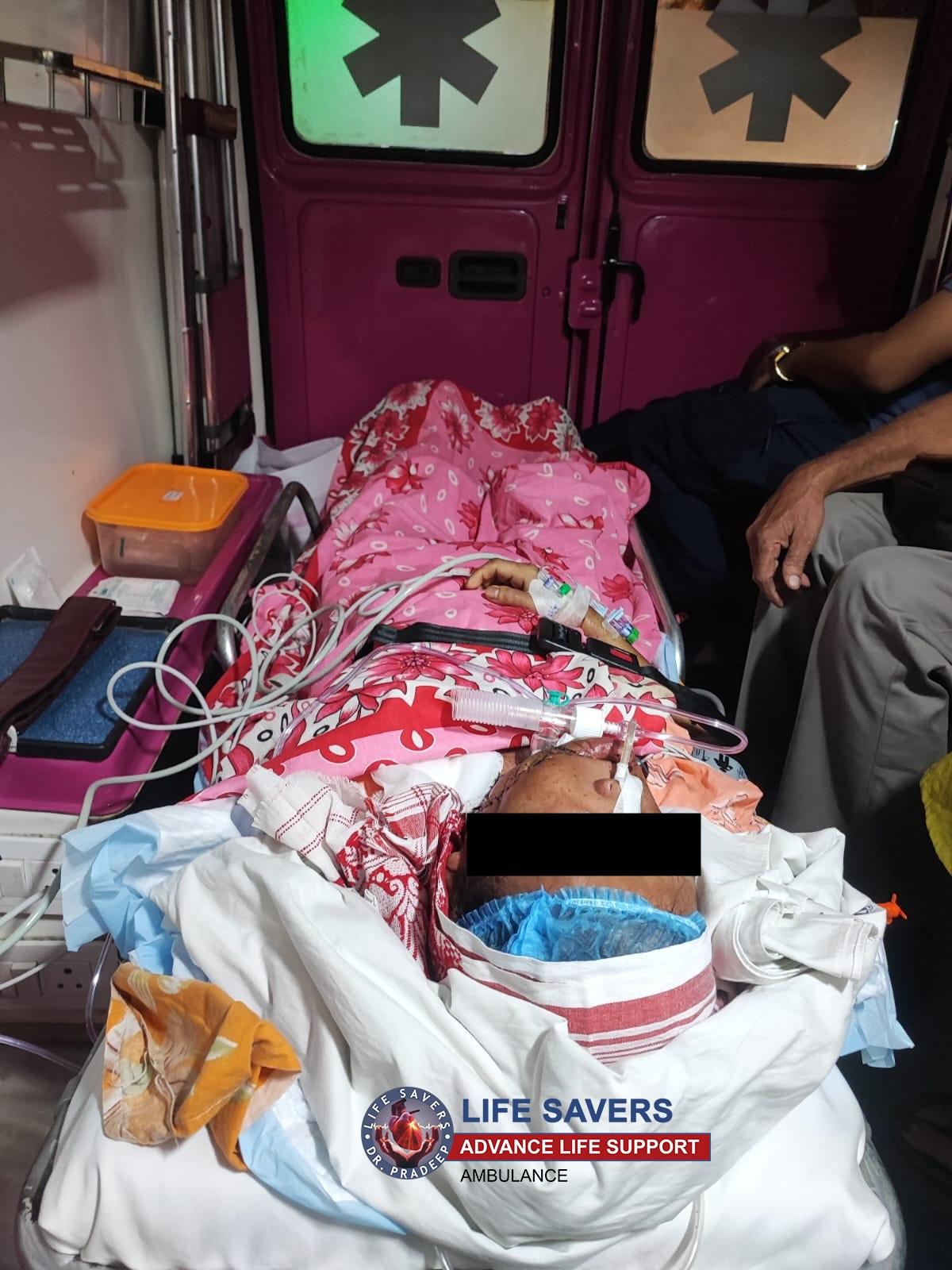
Long-Distance ICU Road Ambulance Transfer from Delhi to Guwahati for a Critically Ill Oncology Patient
Long-distance critical care transport requires meticulous coordination, sustained medical supervision, and condition-specific planning. In this instance, the combination of clinical oversight and logistical preparedness enabled a safe relocation over more than 2,000 kilometres, aligning medical feasibility with the patient’s and family’s needs.
Clinical Background
A 55-year-old female patient undergoing treatment at Dharamshila Hospital, Delhi, was diagnosed with advanced carcinoma of the tongue. As her illness progressed, she required surgical removal of the tongue and a permanent tracheostomy to maintain her airway. At the time of discharge planning, the patient was medically unstable, with severely compromised respiratory function and limited ability to tolerate movement.
The treating team assessed that the patient would require continuous airway care, oxygen support, and close medical supervision if she were to be relocated. The family expressed a strong wish to move her to Guwahati so she could remain closer to her relatives during ongoing care.
Complexity of the Transfer
Relocating a tracheostomised oncology patient over a distance exceeding 2,000 kilometres by road involved multiple clinical risks. The patient required uninterrupted oxygen delivery, regular airway suctioning, and strict monitoring of vital parameters. Extended travel time, variable road conditions, and climatic changes added further challenges to maintaining physiological stability.
Air transport and rail-based medical options were evaluated; however, due to financial constraints and clinical considerations, a carefully planned ICU road ambulance transfer was selected as the most feasible option.
Medical Planning and Transport Strategy
Prior to the transfer, the patient’s condition was reviewed in detail to determine transport suitability. The care team prepared a long-distance transfer plan focusing on airway security, comfort, and continuous monitoring.
A fully equipped ICU road ambulance was configured to function as a mobile intensive care unit. The setup included advanced life support systems, continuous oxygen supply, infusion pumps, suction equipment, monitoring devices, and emergency medications with adequate backup for the entire route.
Onboard Medical Care
The patient was accompanied throughout the journey by a critical care doctor and an experienced paramedic. Their responsibilities included continuous monitoring of oxygen saturation, heart rate, blood pressure, airway patency, tracheostomy tube care, and administration of medications as required.
To minimise discomfort and prevent pressure-related complications during prolonged immobilisation, the patient was positioned on a medical-grade air mattress. Environmental controls within the ambulance were maintained to ensure thermal stability and reduce physiological stress.
Execution of the Delhi–Guwahati Road Transfer
The road journey from Delhi to Guwahati covered approximately 2,015 kilometres, passing through multiple states and varying terrain. The route was planned in advance, accounting for refuelling points, medical contingencies, and rest intervals to ensure uninterrupted care delivery.
During transit, the patient’s vital signs were recorded at regular intervals, and airway management was maintained without interruption. Communication with the patient’s family was continued throughout the journey to provide updates and reassurance.
Despite the extended duration and complexity of the transfer, the patient remained clinically stable for the entirety of the journey.
Arrival and Handover in Guwahati
Upon arrival in Guwahati, the patient was safely transferred under medical supervision to her destination. The continuity of care maintained during transport enabled a smooth handover without clinical deterioration.
For the family, the transfer achieved the objective of bringing the patient closer to home while preserving safety, dignity, and comfort during the final phase of care.
Clinical Perspective
This case demonstrates how structured ICU road ambulance services can support long-distance transfers for critically ill oncology patients when other modes of transport are not viable. With appropriate planning, equipment, and skilled medical escort, extended interstate transfers—such as Delhi to Guwahati—can be carried out safely even in high-risk clinical situations.
Summary
Long-distance critical care transport requires meticulous coordination, sustained medical supervision, and condition-specific planning. In this instance, the combination of clinical oversight and logistical preparedness enabled a safe relocation over more than 2,000 kilometres, aligning medical feasibility with the patient’s and family’s needs.