

Lung Transplant Patient Transfer by Train Ambulance
Published on: November 2025
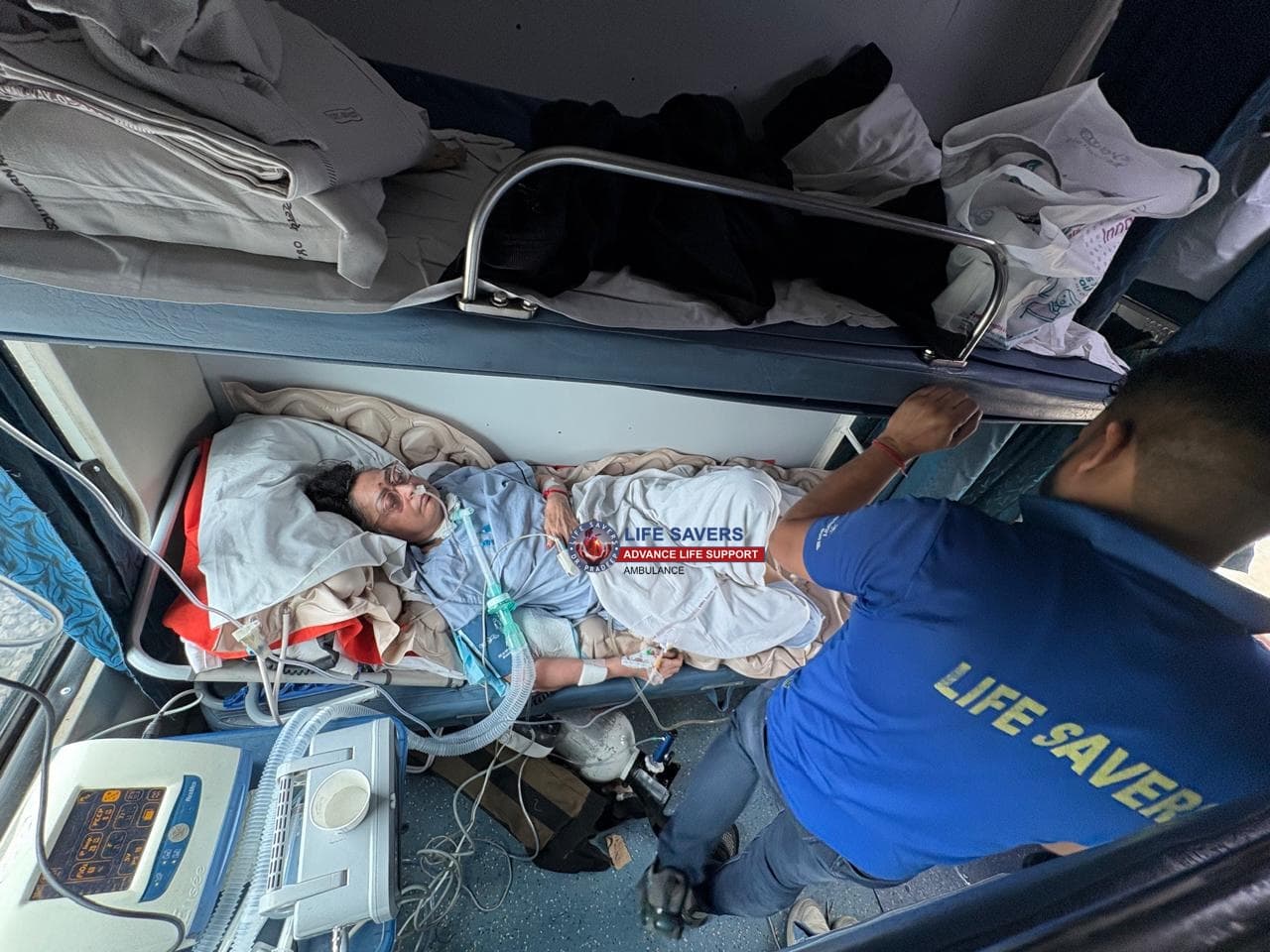
Ahmedabad – Hyderabad | ICU Train Ambulance Transfer for a Lung Transplant Patient
Case Overview
Long-distance transport of critically ill patients demands uninterrupted life support, detailed contingency planning, and an experienced critical care team. In this case, a ventilator-dependent patient requiring a scheduled lung transplant was safely transferred from Ahmedabad to Hyderabad using a fully equipped ICU train ambulance, despite unforeseen challenges during transit.
Patient Condition Prior to Transfer
The patient was diagnosed with advanced end-stage lung disease and had already undergone a tracheostomy. At the time of transfer, the patient was completely dependent on mechanical ventilation and required continuous respiratory and hemodynamic support.
Given that the lung transplant procedure was planned at KIMS Hospital, Secunderabad, timely and stable relocation was essential. Any interruption in airway management or oxygen delivery during transit could have resulted in serious complications.
Selection of Train Ambulance and ICU Configuration
Considering the patient’s fragile respiratory status and the long intercity distance, a train ambulance was chosen as the most suitable mode of transport. A dedicated train coach was configured to function as a mobile intensive care unit.
The onboard medical setup included advanced ventilator support, continuous cardiac and vital-parameter monitoring, infusion pumps for medication administration, suction systems, and an adequate reserve of oxygen cylinders along with a portable oxygen concentrator. This configuration ensured redundancy and preparedness for extended travel duration.
Medical Team and Onboard Supervision
The patient was accompanied throughout the journey by a specialised critical care team, including an ICU-trained physician, paramedics, and nursing staff. The team maintained continuous monitoring of ventilation parameters, oxygen saturation, airway patency, and overall clinical stability.
Strict ICU protocols were followed during transit to ensure that the level of care remained consistent with in-hospital standards.
Unanticipated Delay During Transit
During the journey, the train route was diverted due to heavy rainfall, resulting in a significant delay beyond the initially expected arrival time. Such delays pose a heightened risk in ventilator-dependent cases, particularly with respect to oxygen availability and equipment endurance.
However, the team had anticipated potential contingencies. Adequate oxygen reserves and a backup portable oxygen concentrator ensured uninterrupted respiratory support. Despite adverse weather conditions and extended transit time, the patient remained clinically stable under continuous supervision.
Arrival and Handover at KIMS Hospital, Secunderabad
Following the prolonged but carefully managed journey, the patient was safely transferred to KIMS Hospital, Secunderabad. A structured medical handover was conducted with the lung transplant team, ensuring seamless continuation of care without deterioration during transport.
Clinical Perspective
This case highlights the importance of contingency planning and redundancy in long-distance critical care transfers, especially for organ transplant patients. For routes such as Ahmedabad to Hyderabad, ICU train ambulance services offer a stable environment for prolonged monitoring and life support when air transfer may not be optimal.
Summary
The successful transfer of a ventilator-dependent lung transplant patient across states, despite unexpected route diversion and delays, underscores the role of structured planning, experienced medical escort, and ICU-grade equipment in critical care transport. Continuous supervision and preparedness ensured that the patient reached the transplant centre safely and in a stable condition.